2025 Audi Q5 Reviews, Pricing & Specs
Write a review--
Original MSRP
7.2
of 10
expert review
avg user rating
(0 reviews)
Pros
Comfortable
Standard all-wheel drive
Easy-to-use technology
Cons
Potentially polarizing design
Irritating transmission
High base price
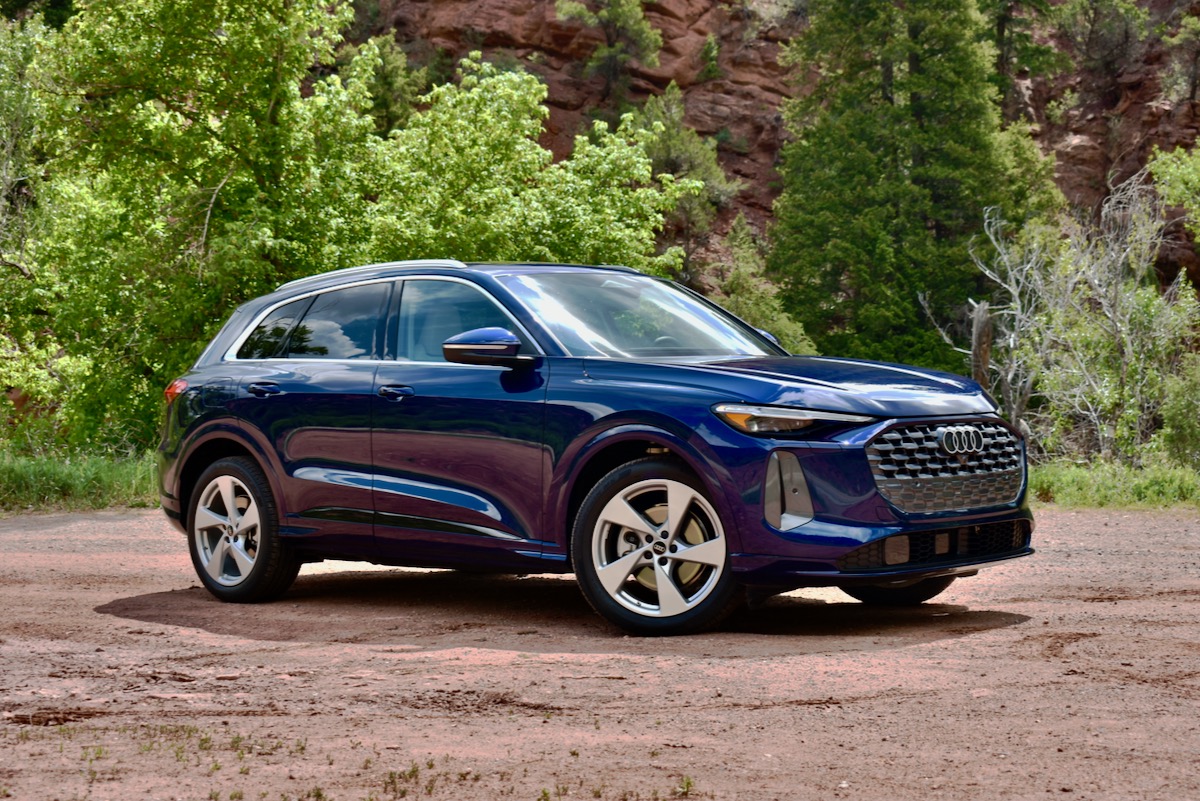
A redesign of Audi’s bestselling model aims for improvements without messing with a winning formula.
Summary: Arriving midway through the model year, the 2025 Audi Q5 compact SUV marks the first redesign of the German luxury brand’s bestselling model since the 2018 model year. That redesign brings Audi’s current design language and tech suite, helping the Q5 keep pace with more recently updated rivals such as the BMW X3, Lexus NX, and Mercedes-Benz GLC.
Verdict: There’s plenty to like about the new Q5, but it’s far from being the definitive small luxury SUV.

This third-generation Audi Q5 leans into SUV toughness. The large, textured grille, prominent side air intakes, and high-mounted headlights give the front end an imposing look, while a network of well-defined lines along the body sides add some musculature. While nothing on the exterior carries over from the previous generation, these new styling elements look more evolutionary than revolutionary, making the new Q5 seem more like a facelift than a redesign.
Trim levels in Canada include base, Progressiv, and Technik, with all but the base model equipped with matrix-design LED headlights and animated taillights. These allow drivers to choose from one of eight patterns for the daytime running lights and to program the OLED taillights with a neat three-dimensional look.
As with the previous-generation Q5, the 2025 model is available in standard crossover SUV and coupe-like Q5 Sportback body styles. The latter sports a lower roof and raked rear window that presents a sleeker profile at the expense of cargo space and rear-seat headroom. Mercedes-Benz offers a comparable GLC Coupe, and the BMW X4 serves as a coupe counterpart to the X3, albeit without the updates that model gets for 2025.
An SQ5 performance grade also remains available with both body styles. In addition to increased power and sport suspension, the SQ5 is distinguished by matte chrome trim (a blackout package is also available), larger front air intakes, a more prominent rear diffuser, and quad exhaust tips. It also comes standard with 21-inch wheels with performance tires, while 19-inch wheels and 20-inch wheels are standard with the Q5 and Q5 Sportback, respectively.
The interior takes the same “more is better” approach as the exterior, piling on details in an effort to create something distinctive. None of the lines of the dashboard and door panels seem to be going in the same direction, as designers had to accommodate the opposing curve of the main touchscreen and doors that bulge with speakers and chunky armrests. The doors house haptic controls for the headlights, mirror adjustment, and door locks on the driver’s side.
The design may be a bit discordant, but materials are at least top-notch. Even the plastics feel fairly sturdy, and the mix of silver and black trim pieces nicely contrasts the available lighter upholstery colours. Leather seating surfaces are standard. A red interior with Alcantara trim and sportier front seats is available on the SQ5, but it doesn’t replace the unfortunate chunk of piano-black plastic that surrounds the cupholders and shifter, which will likely get dirty pretty quickly. And SQ5 seats still lack adequate bolstering for the enthusiastic driving that model was designed for.

All 2025 Audi Q5 models have a seven-speed dual-clutch automatic transmission and quattro all-wheel drive (AWD), with four cylinders of turbocharged power for the base Q5 and six cylinders for the SQ5. The base model’s 2.0-litre turbo-four produces 268 horsepower and 295 pound-feet of torque, while the SQ5’s 3.0-litre turbocharged V6 makes 362 hp and 406 lb-ft of torque.
The standard output is about right for a compact crossover in the Q5’s competitive set. The Audi has slightly less horsepower than an Acura RDX, but more torque. Its torque output also matches the base 2025 BMW X3 30 xDrive, but the Q5 boasts an additional 13 hp. The SQ5 is less powerful than a BMW X3 M50 xDrive, but it nearly matches a Mercedes-AMG GLC 43 in output and splits the difference between the two with a manufacturer-estimated 0-100 km/h time of 4.8 seconds (Audi estimates a 6.2-second zero to 100 km/h time for the standard Q5).
Neither the Q5 nor the SQ5 feels as speedy as the specs claim. The dual-clutch transmission is unable to make quick shifts off the line, and we experienced a surprising amount of turbo lag with both engines. That means there’s a significant gap between hitting the right pedal and sensing any meaningful acceleration. Midrange acceleration is punchier, but the transmission still occasionally exhibits the rough shifts typical of gearboxes lacking a torque converter. The trade-off is usually a sportier, more responsive feel, but we just didn’t get that.
Steel-spring suspension with passive frequency selective damping to help calm suspension movement is standard, while air suspension with adaptive damping is available with the Q5 Technik trim level and standard on the SQ5. The latter gets sportier tuning to help it live up to that Audi S badge.
We were only able to sample the air suspension, which imbues both the Q5 and SQ5 with capable but not sporty handling characteristics. Audi strikes a good balance between damping and body control. These SUVs don’t float over bumps, but they also don’t flop around when cornering. That improves handling while ensuring passengers don’t get car sick from excessive undulations. However, this competent tuning doesn’t encourage attacking corners or late braking, nor does the precise but lifeless steering. If you happen to be on a good driving road, a Q5 or SQ5 won’t waste the opportunity, but it’s hard to imagine seeking out such roads in these SUVs.
Audi includes Off-Road and Off-Road Plus driving modes (alongside pavement-focused Balanced, Individual, Dynamic, and Comfort modes), which raise the air suspension by three centimetres, incorporate hill-descent control, and allow a little more wheel spin, but the Q5 is more at home on dirt roads than technical trails (that’s also the case for its closest rivals).

This redesigned model remains close to the 2024 Audi Q5 in exterior dimensions and interior space. Headroom and legroom in both rows are nearly identical to the outgoing model, but that leaves the 2025 model with merely adequate space compared to rivals.
A sliding and reclining 40/20/40 split-folding second-row bench seat is standard, with helpful cargo-area buttons to lower and raise it from that position. The 2025 Q5 has an additional 48 litres of cargo space behind its second row of seats and nearly 80 litres behind its first row compared to the 2024 model, at 757 litres and 1,710 litres respectively. That also gives this Audi more cargo space than a Lexus NX or Mercedes-Benz GLC, but less than an Acura RDX or a BMW X3.
Audi also makes a power tailgate standard in Canada, along with heated front seats and a heated steering wheel. The Progressiv trim adds heated outboard rear seats and a panoramic sunroof. Ventilated front seats are standard with the SQ5 and all models get what Audi claims is a larger centre console storage bin, but interior storage space isn’t remarkable for a vehicle of this size.
The Q5 also offers up to 2,000 kilograms (4,400 pounds) of towing capacity—enough to make it usable as a tow rig. It also beats the 1,587-kilogram (3,500-pound) towing capacity of a Mercedes-Benz GLC 300 4Matic and the 900-kilogram (2,000-pound) maximum of the Lexus NX.

Whether it’s a Q5 or an SQ5, the standard infotainment setup consists of an 11.9-inch digital instrument cluster and 14.5-inch central touchscreen. The top Technik trim level adds a 10.9-inch touchscreen for the front passenger. Wireless Apple CarPlay and Android Auto are standard, along with a cooled wireless charging pad. Progressiv models add four USB-C ports (two for each row of seats) for device charging, along with a 16-speaker Bang & Olufsen audio system with 3D sound.
The screen setup carries over from the electric Audi A6 e-tron and Audi Q6 e-tron with the same version of Audi’s MMI (Multimedia Interface) infotainment system, which is based on the Android Automotive OS. It’s in keeping with the automaker’s strategy of offering common tech features across its EV and internal combustion vehicle lineups. Luckily for loyal Audi customers, the curved display is easy to see and reach from the driver’s seat. Achieving that perfect positioning means tilting the main touchscreen away from the front passenger, but that’s where the optional third screen earns its keep. Front-seat passengers can play DJ, pull out inclinometer or altimeter readouts, or watch videos (a filter ensures they can’t be seen from the driver’s seat).
A built-in voice assistant can handle some vehicle functions such as climate control, so drivers don’t have to rely on the touchscreen or the steering wheel’s fussy haptic controls. The only blemish from a driver’s perspective is the digital instrument cluster, which despite having the same Virtual Cockpit branding has less functionality than previous versions and reduces the tachometer to a tiny bar that’s easy to miss.
An available head-up display can show speed, driver assistance system warnings, navigation directions, and phone calls. It remained clearly visible in sunny conditions and hovered within our line of sight without actually blocking anything. But as always, drivers of different heights or who prefer different seating positions may not get the same results.
With this redesign, the Q5 also adopts Audi’s Dynamic Interaction Light, a light bar at the base of the windshield meant to provide additional cues to the driver. It flashes in sync with the turn signals and when the vehicle is locked or unlocked, and it provides welcome lighting. But that doesn’t exactly add much to the experience.

Standard driver assist features include: adaptive cruise control, automatic emergency braking and forward collision warning with swerve and turn aids, lane departure warning, parking sensors, automatic high beams, blind spot monitoring and traffic sign recognition. Also standard is an exit alert feature that uses the interior ambient lighting to flash warnings if occupants are about to open the door into the path of an oncoming vehicle or cyclist.
This redesigned model was relatively new as of this writing, so safety ratings from the U.S. National Highway Traffic Safety Administration (NHTSA) were not available. However, the Insurance Institute for Highway Safety (IIHS) ratings were not very favourable. The new Q5 received too many Marginal or Acceptable ratings in the Institute’s crash testing for a Top Safety Pick designation.

Official Canadian fuel consumption ratings were not available for the 2025 Audi Q5 as of this writing. The U.S. Environmental Protection Agency (EPA) estimated combined fuel economy of 9.4 litres per 100 kilometres for the Q5 and 10.7 L/100 km for the SQ5; however, U.S. ratings tend to be lower, as they don’t include as much cold-weather testing.
At the time of writing, the automaker wasn’t discussing bringing back the Q5 plug-in hybrid, but it was still possible to get a plug-in hybrid powertrain with a Lexus NX, Mercedes-Benz GLC, or Volvo XC60.
Audi continues to offer a four-year/80,000-kilometre new vehicle warranty and equivalent powertrain warranty, matching the coverage of most rivals.
Again at the time of writing, pricing started at $62,150 for the base Q5 SUV (all prices included a mandatory $2,850 destination charge plus other fees). Q5 Progressiv and Technik models started at $67,350 and $68,850 respectively. The SQ5 started at $82,150 in Progressiv spec, with the Technik starting at $84,650. The price premium for the Sportback body style varies by trim level.
This puts the new Audi Q5 at the high end of the compact luxury SUV segment. Only the BMW X3 has a higher base price, and the Acura RDX and Lexus NX both start at less than $60,000. The Q5 makes up for that somewhat with lots of standard equipment, a premium interior and chassis tuning, and well-executed tech. However, that still adds up to a new car that’s competent rather than compelling, one that will surely appeal to returning Audi customers but doesn’t make an ironclad argument for itself.


