2025 BMW X7 Reviews, Pricing & Specs
Write a reviewPros
Great handling
Easy-to-use technology
Reasonable value for money
Cons
Potentially polarizing design
Unimpressive interior materials
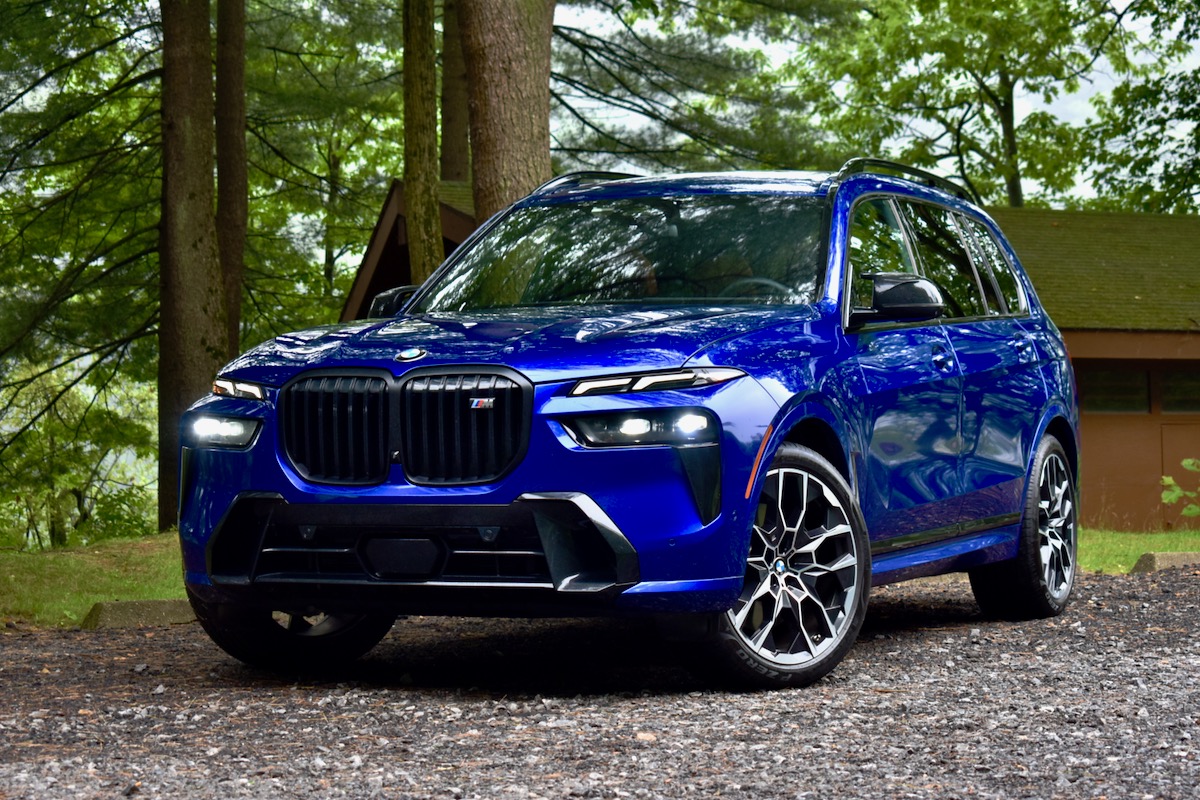
BMW’s biggest SUV upholds the brand’s reputation.
The X7 is BMW’s flagship SUV, providing more space, luxury, and seats for new car buyers looking for a big utility vehicle but wanting to stay in the BMW fold. It arrived for the 2019 model year, received a substantial update for 2023, and continues into the 2025 model year without major changes. Its diverse competitive set includes the Cadillac Escalade, the Lincoln Navigator, the Land Rover Range Rover, the Lexus LX, the Infiniti QX80, and the Mercedes-Benz GLS.
Verdict: BMW loyalists will find more of what they love about the brand, while the X7’s superb driving dynamics and reasonable pricing (for this high-end segment, that is) should give customers of rival brands something to think about.

While not as enormous as the truck-based Cadillac Escalade and the Lincoln Navigator, the BMW X7 has the swaggering presence that full-size luxury SUV buyers crave (or, at least, that the designers of these vehicles do). When it launched as a 2019 model, the South Carolina-built X7 looked like an X5 that was upsized to accommodate North American sensibilities—and with an extra-large twin-kidney grille to drive home the point that this is a BMW.
The styling didn’t get any more elegant with the X7’s most recent 2023 facelift. BMW ditched the more conventional headlights of the pre-facelift X7 for stacked quad lights similar to those of the 7 Series sedan. The grille didn’t get any smaller, but it gained optional nighttime illumination. The current X7 definitely isn’t for wallflowers, but the post-facelift look is at least more distinctive, and helps to set the X7 apart from the smaller BMW X5.
The grille isn’t the only thing scaled to the X7’s generous proportions. Base models come standard with 21-inch wheels, but 22-inch and 23-inch wheels are also available. Our test car came with 22-inch wheels with a dual-spoke design, plus a front end, rear valance, and side skirts with a somewhat boy-racer look, and more “M” badges than you’ll know what to do with, thanks to the M Sport Package. An M Sport Pro Package is also available, primarily adding darkened exterior trim.
Some of the exterior details—particularly the light-up grille and the plethora of “M” badges on M Sport models—seem like BMW was catering to the third owner rather than the first, and unfortunately, that ethos continues inside. The overall interior design is pleasant and simple, but our test car featured a discordant mix of carbon fibre trim, light-up “X7” graphics on the dashboard, and a crystal shift toggle (no big levers here) and rotary infotainment controller.
These details are neat by themselves, but they also seem like a grab bag of things meant to make the cabin feel expensive. They make for a jarring contrast with the traditional diamond-pattern brown Merino leather upholstery. More concerning is that these features are mostly optional extras. Take them away and you’re left with plastic trim that doesn’t feel like a step up in quality from lower-level BMW models.

The 2025 BMW X7 consists of two core models and one specialty performance version, all with standard xDrive all-wheel drive (AWD), an eight-speed automatic transmission, and a 48-volt mild-hybrid system that reduces the engine’s workload to boost fuel economy.
The BMW X7 xDrive40i is powered by a turbocharged 3.0-litre inline-six engine producing 375 horsepower and 398 pound-feet of torque. That will get the xDrive40i from 0-100 km/h in 5.8 seconds, according to BMW. The X7 M60i xDrive benefits from a twin-turbo 4.4-litre V8 producing 523 hp and 553 lb-ft. BMW quotes a 4.7-second zero to 100 km/h time for the M60i xDrive. Both models are electronically limited to 210 km/h as standard, or 250 km/h with optional performance tires.
BMW also continues to sell the niche Alpina XB7, a sportier model from captive tuner Alpina. The XB7 uses an upgraded version of the 4.4-litre V8 rated at 631 hp and 590 lb-ft of torque. BMW says it can reach 100 km/h from a standstill in 4.2 seconds, and its top speed is an Autobahn-worthy 290 km/h, making this the closest thing the Bavarian automaker offers to the hot-rodded Mercedes-AMG GLS 63 or the Cadillac Escalade-V.
You don’t have to spring for the Alpina to get sophisticated chassis tech, though. Standard with the M60i, and part of the Dynamic Handling Package with the xDrive40i, are rear-wheel steering (called Integral Active Steering by BMW) and adaptive air suspension with active roll stabilization. These features combine to nudge the X7 as close to BMW’s “Ultimate Driving Machine” ideal as a three-row, full-size SUV will likely ever get.
Whether navigating crowded streets or enjoying a deserted back road, our BMW X7 M60i test car felt surprisingly nimble for such a big vehicle. The setup of the steering itself, and integration of the rear-axle steering was spot on, making it easy to precisely place the X7 where we wanted it without the car overreacting to small inputs and becoming unsettled. And while the suspension provided a plush ride, it wasn’t so soft as to affect body control. The active anti-roll system helped with this, too, keeping the body flat to inspire cornering confidence while minimizing head toss under acceleration and braking.
This made for a sporty, yet serene driving experience. It was sporty in that the X7 could handle twisty roads with dignity and, in the case of our M60i test car, emit a delightful V8 burble. It was serene because the comfortable ride and quiet cabin made it a proper luxury vehicle, worthy of its high status in BMW’s lineup. The M60i also accelerated quickly but not ferociously, providing some entertainment for any car enthusiasts onboard without making anyone else uncomfortable.

Available in six-seat or seven-seat configurations (depending on whether you choose second-row captain’s chairs or a bench seat), the three-row X7 offers competitive interior space. It has more front-seat headroom than a Mercedes-Benz GLS and a Lexus LX, more second-row headroom than an Infiniti QX80 or Lincoln Navigator, and more third-row headroom than a Cadillac Escalade. Rivals generally offer more legroom, although the X7 at least has a little in its third row than the Infiniti or the Lexus.
At 1,376 litres, the X7 has more cargo space behind its second-row seats than the similarly sized Range Rover, Lexus LX, and Mercedes GLS. This is where the larger footprints of the truck-like Lincoln Navigator, Cadillac Escalade, and Infiniti QX80 are advantageous. The 2,560 litres of space with the second and third rows folded is also much more than you’d get in SUVs of a similar size, but less than the segment’s behemoths.
Behind the third row of seats, the X7 has 362 litres of cargo capacity, which is a tiny shelf left over between the back seats and the bulky split tailgate, relatively speaking. This is a trade-off typical of three-row vehicles, however, and the split tailgate is very useful. The lower half serves as a backstop to keep groceries from tumbling out, or it can be used as a bench for tailgating. It makes sliding long items in and out easier when open. That’s especially helpful given the X7’s tall rear bumper, as is the air suspension’s ability to lower by four centimetres when parked.
A 3,400-kilogram (7,500-pound) maximum towing capacity provides plenty of capability, but isn’t a first-place spec. The Mercedes-Benz GLS can tow up to 3,500 kilograms (7,700 pounds), and most other competitors can tow at least 3,600 kilograms (8,000 pounds). BMW’s semi-automated park assist system can reverse the X7 with a trailer attached, though, and for non-trailering situations there’s also a low-speed Maneuver Assistant that can remember the path through tight driveways.

The X7 features BMW’s Curved Display setup, which is similar to many of the automaker’s other current models. A 12.3-inch digital instrument cluster and 14.9-inch touchscreen are mounted side-by-side under one piece of glass, making for an attractive layout that doesn’t overpower the rest of the interior. Unlike some other automakers, BMW has also taken full advantage of the digital cluster by coming up with some imaginative designs, such as the angled forms of the speedometer and tachometer.
BMW’s iDrive infotainment system was one of the first of its kind. The latest iteration, based around version 8.5 of BMW’s operating system, is thankfully a lot easier to use than the earlier ones. It retains the signature rotary controller, surrounded by shortcut buttons for certain menus. However, that’s almost redundant thanks to a sensible screen layout, standard wireless Apple CarPlay and Android Auto, and steering wheel controls. Those are real buttons that provide physical feedback, making them much easier to use than the capacitive controls of rival Mercedes-Benz.
Like Mercedes (and Audi), BMW includes a natural-language voice recognition system as standard equipment. However, perhaps due to our seating position’s distance from the microphone, the system had trouble hearing us in the X7. Nearly every command had to be repeated loudly, as the system either only caught snippets or missed what we were saying entirely. This isn’t a problem we’ve noticed with other BMW models equipped with the same voice-recognition tech, but perhaps it might be a good idea to do a sound check with your prospective X7 purchase.
The X7 also features digital-key functionality, allowing a smartphone to serve in place of the key fob, as well as augmented reality navigation that presents a live video feed with overlaid arrows to show where to turn. Both features are also available from other brands, while BMW’s gesture control remains unique for a reason. In theory, it lets you do things like adjust audio volume with hand movements, but in reality, figuring out the precise movements to make it work (and not trigger it accidentally) is more trouble than it’s worth.

Even at the X7's high price point, BMW doesn’t include all driver-assist features as standard. Forward collision warning, automatic emergency braking, blind-spot monitoring, park assist, and lane-keep assist are standard, while adaptive cruise control (with stop-and-go functionality), traffic jam assist, and BMW’s hands-free Highway Assistant system are part of the Advanced Driver Assistance package.
Highway Assistant can manage acceleration and braking while keeping the car centred in its lane, and it also includes an automated lane-change function. It’s useful for long highway slogs but isn’t as sophisticated as the Super Cruise system available with the Cadillac Escalade. The latest update for that system can recognize highway off-ramps, allowing vehicles to negotiate interchanges without disengaging the system.
Safety ratings from the Insurance Institute for Highway Safety (IIHS) and National Highway Traffic Safety Administration (NHTSA) were not available at the time of writing.

Natural Resources Canada fuel economy ratings top out at 10.7 litres per 100 kilometres combined (11.6 city and 9.6 highway) for the six-cylinder X7 xDrive40i, while the V8-powered X7 M60i xDrive is rated at 13.3 L/100 km combined (14.7 city and 11.6 highway). Interestingly, NRCan rates the Alpina XB7 at 13.6 L/100 km combined and 15.2 city, but the highway rating is the same as in the M60i.
These numbers aren’t terrible for a market segment that doesn’t prioritize efficiency, and the xDrive40i even gets slightly better ratings than the Lexus LX 700h hybrid. Likewise, BMW’s four-year/80,000-kilometre new-vehicle warranty is within the norms of established luxury brands. When it comes to pricing, though, the BMW has a clear advantage over comparable large SUVs. Starting at $113,500 (not including a $2,555 destination charge and other fees), the X7 xDrive40i is a few grand less than a base Mercedes-Benz GLS and much less than a Range Rover, a Lexus LX, or a Lincoln Navigator. For those who prioritize space and towing capability over on-road handling, though, the similarly priced Infiniti QX80 is worth a look.
The X7 M60i xDrive and Alpina XB7 are big steps up in price at $132,000 and $175,000 before fees respectively. But while you’ll miss out on a little V8 rumble, the base model can be imbued with similarly impressive driving dynamics by selecting the Dynamic Handling Package. That leaves a vehicle that, as much as any of its rivals, gives equal weight to both the “sport” and “utility” sides of the SUV equation.


