The Nissan Titan was the brand’s first — and thus far only — foray into the full-size truck market, going head-to-head with the likes of the Ford F-150, Toyota Tundra, and Chevrolet Silverado 1500. Though it hit the automotive scene with a standard powerful V8 engine and some upmarket amenities for a truck, it fell behind its competitors in configurability. Some of that was fixed in the second generation with the introduction of the two-door single-cab option, but homegrown full-size trucks from the likes of Ford, Chevy, GMC, and Ram just offered more options than Nissan trucks including more powertrains, more cab and bed configurations, more payload capacity, and superior fuel economy.
Nissan Titan Buying Guide: Cost, Reliability, and the Best Years to Buy
Search for Nissan Titan
See all


What set the Titan apart, however, was its off-road performance and comfortable interior. The Titan offered standard features such as Bluetooth phone connectivity, air conditioning, and back-up cameras before they were popular on trucks. It also offered a unique UtiliTrack channel system and in-bed cargo boxes for better load management. And on top of that, it had a decent reputation for reliability.
The full-size truck market was a tough nut to crack for Nissan. Poor ride quality, a lack of configurability, and plasticky interior materials counted against the Titan. While it was Nissan’s most popular model in some parts of Canada, sales more broadly never quite took off. The truck was discontinued in Canada after the 2021 model year and globally after 2024 so the company could focus on the midsize Nissan Frontier. Our buyer’s guide explains the ins and outs of buying a used example.
Nissan Titan: Cost, Reliability, and the Best Years to Buy
- Frequently Asked Questions
- Nissan Titan Pros and Cons
- Nissan Titan Generations
- Nissan Titan Second Generation (2017–2024)
- Nissan Titan First Generation (2004–2015)
Frequently Asked Questions
Which Nissan Titan years are the best?
According to CarComplaints.com, Titan model years with the fewest complaints are the last few years before the end of the generation. Model years 2012 to 2015 for the first generation and 2020 and 2021 for the second are where you want to be looking.
What are the worst Nissan Titan years?
The earliest model years, 2004 and 2005, are best avoided due to the number of reported problems. These include a rear axle failure for the 2005 model year, which is definitely one to watch out for on a test drive. However, according to CarComplaints.com, 2018 is the worst year to buy because of costly drivetrain issues.
Is a used Nissan Titan a good deal?
In Canada, late-model Nissan Titans have held their value surprisingly well compared to more traditional truck options like the Ford F-150 and Chevrolet Silverado. Part of this is an overall lack of market saturation: there just aren’t as many used Nissan Titans kicking around. We therefore can’t say a Titan is a good deal relative to the rest of the used truck market, but it does make for a viable alternative if you’re looking for a truck that’s not from the Detroit Three.
Nissan Titan Pros and Cons
Pros:
- Powerful engine
- Quiet cabin
- Accesible tech
Cons:
- Poor fuel economy
- Limited bed and cab configurations
- No alternative engines
Nissan Titan Generations
Nissan Titan Second Generation (2017–2024)
The Nissan Titan skipped a model year going into its second generation. The automaker launched the heavy-duty Nissan Titan XD in 2016 before the full-size, light-duty Titan lineup appeared for the following year.
Though the brand-new Titan was still equipped with a 5.6-litre V8, which was the only engine option with this full-size pickup truck, it got a boost to 390 horsepower and 394 lb-ft of torque along with a new seven-speed automatic transmission. Nissan promised a base V6 engine, but it never materialized before the truck’s demise in 2021. Rear-wheel drive (RWD) was standard and four-wheel drive (4WD) was available throughout the second-generation Titan’s run.
Initially offered in single-cab, two-door and crew-cab, four-door configurations, a King Cab (four-door, extended cab) version was added in late 2017. The Titan crew cab was available with S, SV, Pro-4X, SL, and Platinum Reserve trims, whereas the single cab appealed to the work truck segment and was only available in S trim. When it joined the line-up, the Titan King Cab was offered in SV and Pro-4X trims. There were three truck bed lengths available depending on the cab configuration: 5’5” with the crew, 8’ with the single, and 6’5” with the King.
In addition to a bolder exterior, the interior trim got a complete refresh including moving the gearshift to the column, a centre console large enough to store a 15-inch laptop, and Nissan’s Zero Gravity seats. Other key features on the second-gen Titan included Bluetooth phone connectivity, push-button ignition, and a back-up camera. Available features included navigation, SiriusXM satellite radio, an electronic locking rear tailgate, an electric locking rear differential, hill descent control, a trailer tow package with integrated trailer brake controller, LED signature headlights, premium leather seats, heated and cooled front seats, chrome front and rear bumpers, a chrome front grille, and a Rockford Fosgate premium audio system.
The infotainment system was upgraded in 2019 to a 7-inch colour touchscreen display with Apple CarPlay and Android Auto smartphone functionality. A new premium Fender audio system became available.
A refresh in 2020 saw the discontinuation of the single cab and King cab models, a horsepower boost, a new nine-speed Jatco automatic transmission and an available nine-inch infotainment screen. Nissan’s Safety Shield 360 also became standard and included features such as lane departure warning, high beam assist, automatic emergency braking, rear automatic braking, blind spot warning, rear cross-traffic alert, and forward collision warning. Intelligent cruise control was optional.
In a brief search, we saw prices of second-generation Nissan Titan examples range widely from $14,000 for very high-kilometre trucks to more than $40,000 for late-model Pro-4X crew cab trucks.
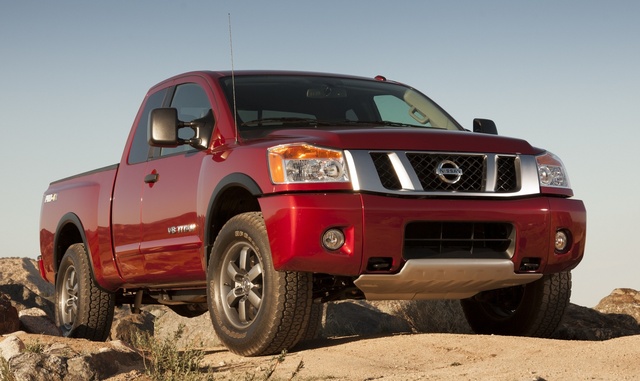
Nissan Titan First Generation (2004–2015)
The first-generation Nissan Titan was the brand’s inaugural entry in the full-size truck market. It was developed, designed, and engineered primarily in North America and built at Nissan’s plant in Canton, Mississippi. Original trim levels included the XE, SE, and LE.
The Titan shared a body-on-frame platform with the Nissan Armada and the Infiniti QX56. It had just one powertrain option, a 5.6-litre V8 engine that delivered 305 horsepower and 379 lb-ft of torque. It was mated to a five-speed automatic transmission and had a maximum towing capacity of 4,300 kilograms (9,500 pounds).
The Nissan Titan was only available with two cab configurations, a King Cab (extended) or crew cab. There was no two-door regular cab in the first generation. At launch, the King Cab got a 6’7” bed, and the crew cab got a 5’7” bed. Starting in 2008, the Titan offered a longer wheelbase model with longer beds for both cab configurations. It was available with both RWD and 4WD drivetrains.
The base Nissan Titan XE offered standard features such as 17-inch wheels, a split bench seat, power steering, four-wheel antilock brakes, cruise control, power windows, and heated side mirrors. Available features included a Rockford Fosgate premium audio, front seat captain’s chairs, and sunroof. The truck also offered a Pro-4X off-road package with Rancho performance gas shocks, BF Goodrich Rugged Trail tires, skid plates, fog lamps, and tow hooks.
The first-gen Titan got a small design refresh in 2008 and added the Titan Pro-4X model. In 2011, the base trims were renamed to S, SV, and SL.
Used first-generation Nissan Titans aren’t especially common in Canada anymore. We saw prices from $6,000 for trucks with nearly 300,000 kilometres to about $30,000 for later-model Pro-4X crew cab models.
Related Topics


by Jill Ciminillo
Jill Ciminillo is a Chicago-based automotive writer, influencer, TikTok Creator, YouTube personality, and podcast host, with her articles appearing on websites such as U.S. News & World Report, Capital One Auto Navigator, Consumer Guide Automotive, A Girl's Guide to Cars, and Drive Chicago. Additionally, she co-hosts a weekly Car Stuff radio show via Talk Zone. Previously, Jill has been the automotive editor for the Chicago Sun-Times News Group as well as Sinclair Broadcast Group. She is also a past president for the Midwest Automotive Media Association and has the distinction of being the first female president for that organization. Jill is also currently a juror for the North American Car, Utility and Truck of the Year (NACTOY) and Women's Worldwide Car of the Year (WWCOTY).
The content above is for informational purposes only and should be independently verified. Please see our Terms of Use for more details.


